
Reformer Pilates vs Mat Pilates, What’s the Difference?
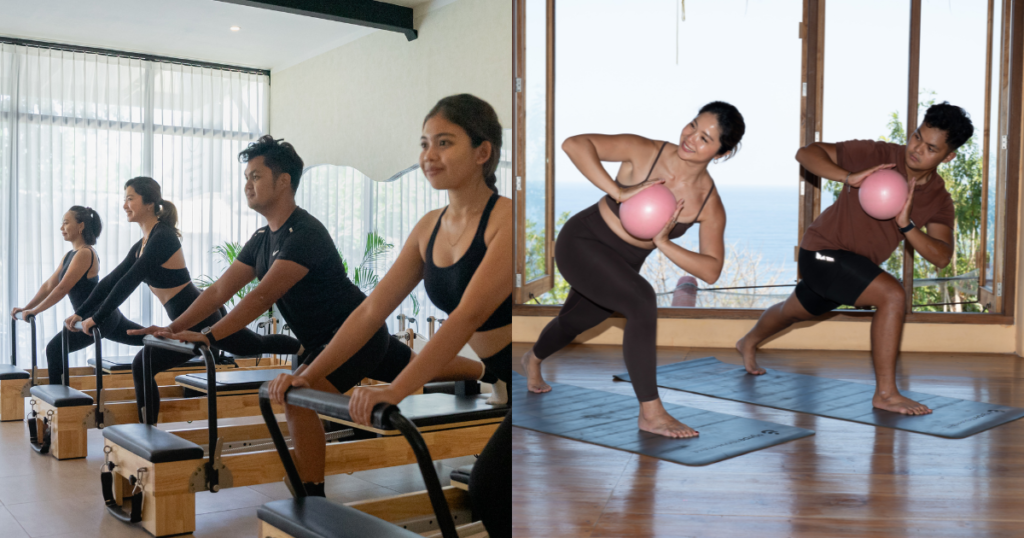
If you are exploring Pilates classes, you may have noticed two common options: Reformer Pilates and Mat Pilates. Both are based on controlled, intentional movement, but the experience can feel quite different.
One uses specialised equipment with springs, straps, and a moving carriage. The other uses a mat and your body weight as the main source of resistance. So, is one better than the other?
Not necessarily. Reformer Pilates and Mat Pilates share the same movement principles, but they offer different ways to practise. The right option depends on what you enjoy, the type of support you prefer, your goals, your access to a studio, and how you like to move.
Not necessarily. Reformer Pilates and Mat Pilates share many of the same movement principles, but they offer different ways to practise. Pilates generally focuses on controlled, purposeful movement, with attention to strength, mobility, balance, and body awareness.[1]
The Short Answer: What Is the Main Difference?
The clearest difference is the equipment.
Reformer Pilates uses a machine with a sliding carriage, springs, straps, shoulder supports, and a footbar. The equipment provides adjustable resistance and support while you move.
Mat Pilates is performed on a mat, usually using body weight, gravity, and controlled positioning to create the challenge. Small props such as rings, balls, or bands may sometimes be added.[2]
Both formats can focus on:
- Core control
- Strength
- Mobility
- Stability
- Balance
- Coordination
- Posture
- Breathing
- Body awareness
- Controlled movement
The method is similar, but the tools and movement environment are different.
What Is Reformer Pilates?
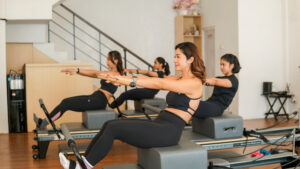
Think of the Reformer as a moving platform that gives your body both resistance and support.
The carriage slides along a frame, while springs control the amount of tension. The footbar and straps allow you to work in different positions and create a wide range of exercises.
The equipment can make movement feel more guided. It can also create a more dynamic challenge because your body needs to control the carriage as it moves.
Depending on the exercise, you may use the Reformer to:
- Push the carriage away with your feet
- Control the carriage as it returns
- Move your arms or legs using straps
- Practise balance with support
- Strengthen different muscle groups
- Explore movement through a controlled range
The springs are not simply there to make the workout harder. They can also assist a movement or give you feedback about how your body is organised.
For a closer look at the equipment and class environment, read our guide on what to expect in your first Reformer Pilates class.
What Is Mat Pilates?
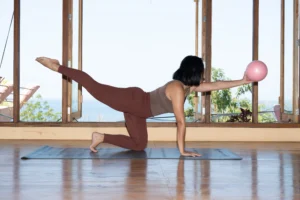
Mat Pilates uses a mat as the main equipment. Many exercises are performed lying down, sitting, kneeling, or standing, with the body working against gravity.
Without a moving carriage or spring system, you may need to create resistance by changing your body position, adjusting the length of your limbs, or holding a position with control.
Mat Pilates can include movements that focus on:
- Trunk and core control
- Spinal mobility
- Hip stability
- Shoulder organisation
- Leg strength
- Balance and coordination
- Breathing and concentration
Some classes use small props, such as Pilates rings, resistance bands, soft balls, or light weights. These can add variety, feedback, or an extra challenge without changing the basic mat based format.
Mat Pilates can also be easier to practise outside a studio because it requires less equipment. This may make it a practical option for people who want to move at home or travel frequently.
Reformer Pilates vs Mat Pilates: A Clear Comparison
Reformer Pilates
-
Main equipment: Reformer machine with springs, carriage, straps, and footbar.
-
Resistance: Springs, body position, and carriage control.
-
Movement experience: Guided by a moving carriage and adjustable resistance.
-
Support: Equipment can provide support or assistance.
-
Studio access: Usually practised in a Pilates studio.
-
Class setting: Often instructor-led in a specialised studio.
-
Variety: Many equipment-based movement variations.
-
Cost and access: Requires access to a Reformer studio.
-
Best suited to: People who enjoy equipment, adjustable resistance, and guided movement.
Mat Pilates
-
Main equipment: Mat, sometimes with small props.
-
Resistance: Body weight, gravity, body position, and optional props.
-
Movement experience: More direct connection with the floor and body weight.
-
Support: Support mainly comes from the mat, floor, and instructor.
-
Studio access: Can be practised in studios, at home, or while travelling.
-
Class setting: Available in group classes, private sessions, or home practice.
-
Variety: Broad range of mat and prop based exercises.
-
Cost and access: Often easier to access with minimal equipment.
-
Best suited to: People who prefer simplicity, portability, and bodyweight work.
This comparison is a starting point rather than a rule. Both formats can be adapted for different levels and movement goals.
How Does the Resistance Feel Different?
Resistance is one of the most noticeable differences between the two formats.
On the Reformer, springs create tension as the carriage moves. You may feel resistance while pushing the carriage away or while controlling its return. Changing the springs can change the way an exercise feels.
In Mat Pilates, the challenge often comes from maintaining control against gravity. A movement may become more demanding when you extend your arms or legs, change your position, slow down, or hold a stable shape.
Neither type of resistance is automatically better. They simply give you different feedback.
The Reformer may make resistance more adjustable and visible. Mat Pilates may encourage you to notice how your own body creates stability without the same external support.
Which Format Is More Beginner Friendly?
Both can be suitable for beginners.
Some people find the Reformer helpful because the equipment provides structure, support, and clear feedback. Others prefer Mat Pilates because the setup is simpler and there are fewer unfamiliar components to learn.
Your personal preference may depend on how you like to receive instruction. If you enjoy having an apparatus guide the movement, Reformer Pilates may feel engaging. If you prefer a more minimal environment, Mat Pilates may feel easier to approach.
Being a beginner does not automatically mean you should choose one format over the other. The quality of instruction, the class level, and the way the session is adapted are often more important than the equipment itself.
If you are still wondering whether Pilates is appropriate for your current fitness level or experience, read Is Reformer Pilates good for beginners?.
Which Format Supports Strength and Mobility?
Both formats can help you explore strength, mobility, stability, and control.
The Reformer offers resistance through springs and allows you to work in different positions. It may be useful if you enjoy changing the direction of movement or working with external support.
Mat Pilates develops strength through body positioning and control. It may be particularly useful for learning foundational patterns without relying on a machine.
Mobility also looks different in each format. The Reformer can support the limbs with straps or the carriage while you explore a movement. On the mat, you may need to create more of the stability yourself while moving through a comfortable range.
Both formats can support strength, mobility, control, and body awareness, although the equipment creates a different movement experience in each one. For a closer look at the potential benefits of Reformer Pilates, read our guide to the benefits of Reformer Pilates.
Rather than asking which format gives better results, it may be more useful to ask:
- Which type of resistance do I enjoy?
- Do I prefer equipment or simplicity?
- Do I want more external support or more bodyweight control?
- Which option can I attend consistently?
- What kind of class environment helps me stay engaged?
A movement practice becomes more useful when it fits realistically into your life.
Which Format Is More Accessible?
Mat Pilates generally requires less equipment. You may be able to practise with only a mat and comfortable clothing, making it easier to continue at home or while travelling.
Reformer Pilates requires access to a specialised machine and usually takes place in a studio. This can make it less portable, but it also offers access to equipment and instructor guidance that may not be available at home.
For some people, studio access is part of the appeal. Attending a class can create structure, community, and a consistent time for movement. For others, the ability to practise Mat Pilates almost anywhere may be more practical.
Accessibility is not only about the equipment. It is also about location, schedule, class size, price, instruction style, and what helps you feel comfortable enough to return.
Can You Practise Both?
Yes. Reformer Pilates and Mat Pilates can complement each other.
A person may enjoy the support and variety of the Reformer while using Mat Pilates to practise basic movement patterns elsewhere. Another person may prefer mostly mat-based classes but occasionally use the Reformer for a different type of resistance.
Practising both can help you experience similar principles in different environments. You may notice how your body responds when it has the support of the machine compared with when it needs to create more stability against gravity.
There is no requirement to choose one format permanently. Your preference may change depending on your schedule, goals, experience, and how your body feels.
How to Choose Between Reformer Pilates and Mat Pilates
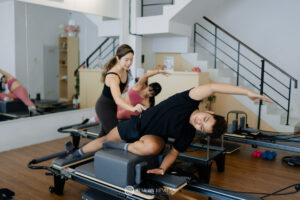
Use this quick guide as a starting point.
Reformer Pilates may suit you if you:
- Enjoy instructor led studio classes
- Like adjustable resistance
- Prefer equipment that provides support and feedback
- Want to explore a wide range of movement variations
- Enjoy a structured class environment
- Are interested in private or small group instruction
Mat Pilates may suit you if you:
- Prefer a simple setup
- Want to practise at home or while travelling
- Enjoy bodyweight based movement
- Have limited access to a Reformer studio
- Prefer a lower equipment approach
- Want to build a consistent practice with minimal preparation
These are not fixed categories. You can enjoy both, and your choice does not need to reflect your fitness level or ability.
Which One Should You Try First?
The best starting point is the format that feels realistic, welcoming, and interesting to you.
If you have access to a Reformer studio and enjoy the idea of guided equipment-based movement, starting with a beginner-friendly Reformer class may be a good option. If you prefer simplicity or want to practise more independently, Mat Pilates may be a natural first step.
You can also speak with an instructor before booking. Ask about the class format, experience level, equipment, and available modifications.
INSTRUCTOR TIPS
“There isn’t one Pilates format that’s better for everyone. When someone is deciding between Reformer and Mat Pilates, I usually encourage them to think about how they like to move, what kind of guidance they prefer, and what they can practise consistently. Both can be a great place to start.”
Dieva, Agape Movement Instructor
At Agape Movement, the Pilates Classes program page includes Reformer Pilates, Mat Pilates, private sessions, and other movement formats. Exploring the available classes can help you compare the options and find what fits your routine.
Reformer Pilates and Mat Pilates: Different Tools, Shared Principles
Reformer Pilates and Mat Pilates are not competing versions of movement. They are two ways of exploring many of the same principles.
Both can encourage you to move with intention, build body awareness, and develop strength and control over time.[3] The main difference is how the equipment shapes the experience.
The Reformer offers springs, a moving carriage, straps, and additional support. Mat Pilates offers simplicity, portability, and a direct relationship with body weight and gravity.
There is no universal winner. The better choice is the one that suits your preferences, goals, access, and consistency.
When you are ready to explore Pilates in person, find an Agape Movement studio and discover a class that feels right for your movement journey.
Important: Reformer Pilates and Mat Pilates can both be suitable forms of exercise, but individual needs and circumstances vary. If you have an injury, medical condition, ongoing pain, or specific rehabilitation needs, consult an appropriate healthcare professional before starting a new exercise routine.
Footnotes
- Pilates Foundation. “About Pilates.” https://www.pilatesfoundation.com/about-pilates. Accessed October 2026.
- Cleveland Clinic. “Pilates 101: What It Is and Health Benefits.” https://health.clevelandclinic.org/everything-you-want-to-know-about-pilates. Published March 10, 2023.
- Kloubec, June. “Pilates: How Does It Work and Who Needs It?” Muscles, Ligaments and Tendons Journal, 2011. Available through PubMed Central: https://pmc.ncbi.nlm.nih.gov/articles/PMC3666467/.